How Sweden will be invaded
An
interview with the defected Czech general Jan Sejna in the newspaper
Barometern 1978
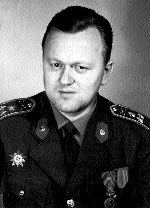
For many years, the Czech general Jan Sejna
held a central position in the political and military life of his
country and in the military organization of the Warsaw Pact states.
He was in the inner circle where he met the highest Russian leaders
and the top figures of the satellite states. After a few years as a
farm and laborer, he enlisted in the army at the age of 22, underwent
officer training and then made a very rapid career: major at the age
of 27 and at the same time elected to the Central Committee of the
Czech Communist Party as its youngest member, then head of the
Secretariat of the Minister of Defense, member of the “Collegium”
of the Ministry of Defense where the country’s 10 highest
military commanders sat and at the age of 40 major general. He then
held 18 different assignments and positions, most of them at a high
level.
Secret
He was mainly
concerned with the policy, strategy and tactics of the Czech Armed
Forces and with intelligence and sabotage planning. He gained
extensive and detailed insight into the Warsaw Pact countries' and
thus the Soviet Union's entire planning for war, sabotage and
espionage throughout the world, primarily Western Europe, and access
to very secret material.
Escaped
He gradually lost
faith in communism and in his country's regime. A few months before
the Russian invasion of Czechoslovakia in 1968 – which he knew
about in advance – he fled to Trieste to create a future for
himself in the free world. He was granted asylum in the United
States, where he has since lived in secret. His defection had
immediate and startling consequences:
Czech Minister of
Defense General Lomsky was forced to resign, as was Interior Minister
Josef Kudrna, State Prosecutor Jan Bartusjka, the head of the Prague
section of the Russian security service KGB, Lieutenant Colonel Jiri
Podecepicki, and several others.
Deputy Czech Minister of
Defense General Vladimir Janco – one of Sejna’s closest
friends and colleagues – committed suicide.
Great
fear
A large investigative apparatus was set in motion by
Russian orders when Sejna’s escape became known. Hundreds of
people were interrogated. With Czech help, the Russians spread
information that he was a Stalinist, as well as other information to
discredit their former top man. Such was the fear of the revelations
he could be expected to make.
Several governments in the West
have received Sejna’s information – both his oral
information and the secret file material he managed to get with him
during his escape. During several days of talks with General Sejna at
a location in the United States, he presented parts of his very
extensive material and spoke in detail about his time at the top of
the communist state.
Invasion of Sweden
The Soviet
Union's plan for the invasion and occupation of Sweden includes
airborne landings of large forces, including tanks, primarily in two
places: near Eskilstuna – Mariefred and in the Östersund
area. At the same time, a large Russian army is attacking from
Finland against northern Sweden.
The plan is intended to be
implemented along these lines in a situation where a new world war
has broken out and when the Soviet Union has started the war by first
firing from its bases in Eastern Europe and at the same time
launching the major attack against Central Europe to reach the
Atlantic coast.
Sweden is important to the Soviet Union
primarily as a transit country to reach the NATO bases in Norway and
Denmark and gain full control over the entire Scandinavian Atlantic
and North Sea coast, says General Sejna. Norway and Denmark are so
strategically important because there are NATO bases there.
Therefore, both of these countries must be taken quickly.
Swedish
industries
The Russians do not expect any alternative to an
attack through Sweden. That Sweden would be left unoccupied in such a
situation has been completely ruled out in all Russian plans.
Firstly, Swedish territory would then be left open for NATO forces to
land troops and establish bases on which the Russians will never
allow. What they are mainly counting on is that NATO will try to
occupy the Swedish airfields in order to be able to use them.
Secondly, the Russians have the important aim of quickly getting
Swedish industry under their control.
Sabotage troops
If
Sweden is attacked in connection with the outbreak of a world war –
that is, when the USA remains in Europe and NATO exists, the Soviet
Union expects to use its nuclear weapons first and to primarily
direct them at the NATO bases. Given the Russian intentions with
Sweden, the Russians would probably prefer to avoid a nuclear attack.
However, this depends on the current situation at that time. The fact
that tactical nuclear weapons will be used cannot therefore be
considered completely ruled out.
In a limited conflict where
the US is not the opponent, the Russians expect not to have to use
their nuclear weapons at all, for example in an operation against
Finland, a Scandinavian country or Berlin. This is the perspective
for you.
Attack at night
As far as Sweden is
concerned, the only thing I can say for sure is that the attack is
expected to be launched at night.
Airdrops together with
sabotage operations play a very important role in the plans to occupy
Sweden. You can count on extensive sabotage that is launched at the
very moment of the attack. The sabotage operations will be of
decisive importance for the Russians' ability to put your defense out
of action, especially since sabotage groups are also included in the
forces that are airdropped in the first days of the war. Sabotage
plays an enormous role in Russian war planning. In your country, the
Russians expect that most of the targets will be able to be destroyed
by sabotage when the planning is completed, and that is intended to
be in 1978.
Everything is important
You understand,
as I have previously pointed out, that I have not been able to see
the Russian attack plan in its entirety. What I have seen is the
Czechoslovak one and parts of the East German and Russian ones. But
since discussions must be held during these exercises and maneuvers,
you learn a lot from conversations with, for example, the Polish
Minister of Defense and with Polish and Russian high-ranking
officers.
During the years I held high positions, all
important issues concerning the Warsaw Pact passed through my hands.
In addition, information has come to me even after I left
Czechoslovakia.
Large forces
On the very first day
of the attack, large forces are to be airborne in Sweden, and I know
of at least two areas where extensive airborne landings are expected:
in the Östersund area and in the Eskilstuna-Mariefred area. In
the Östersund area to secure the attack route towards the
important Trondheim area in Norway and in the Eskilstuna-Mariefred
area partly to secure communication routes and attack routes to the
west, partly to take Stockholm from the rear, so to speak. The
majority of the force that is being landed in the
Eskilstuna-Mariefred area and that will receive armored vehicles
air-landed will continue westward. Gotland will be taken by
air-landing together with marine infantry units.
Tanks are airdropped
Airdrops
play a very important role in occupying Sweden. The Russians are
clearly aware that the terrain in Sweden and Finland is not ideal for
them. It is therefore important to get as large a force as possible
to favorable assembly points for continued attacks. They should not
have to drive long distances first, which is why airdrops are very
important in Sweden. They are carried out both by parachute and by
landing aircraft. In places where it is difficult to land even with
specially built planes, parachutes are also used to land artillery
and smaller tanks. I have myself seen such exercises where the
results were very impressive. And not just exercises: when the
Russians marched into Czechoslovakia in 1968, all the Russian tanks
that entered Prague came directly from Prague airport. They had all
been airdropped from aircraft since the airport was occupied by the
Russians.
North Calotte
Other routes that the
Russian attack on Sweden will have are partly by land through
Finland, partly across the Baltic Sea and the Bothnian Sea with large
transport fleets that go to pre-selected ports. It is known that the
Russians have recently (1978) introduced a new type of armed forces;
marine infantry.
The Russians do not expect any resistance in
Finland, which is expected to immediately give in to Russian demands
for a march through. The Russian troops - including armored troops -
who are to invade northern Sweden and from there continue into Norway
expect to be able to go directly through Finland and then break
through the Swedish border.
At Öland
To conquer
the North Calotte itself, the Russians are primarily counting on
large landings from ships on the Norwegian Arctic coast and the North
Atlantic coast plus air landings in northern Norway. Taking northern
Norway quickly is a vital Russian interest.
In Sweden, the
seaborne troops are deployed in Stockholm, Gävle and Umeå
and I recall that some port on Öland was also mentioned.
400
Ships
To make these seaborne transports on a very large scale
possible, the Soviet Union has in recent years made great efforts to
strengthen its fleet. When the Czech Minister of Defense Lomsky once
returned from a meeting in the Soviet Union, he was almost shocked
that the Soviet Navy had spent so much money on its modernization, on
replacing cannons with rockets and much more. Their fleet has immense
firepower in addition to its transport capacity. The Arctic Fleet and
the Baltic Fleet represent an enormous force right under your
windows, so to speak. When the commander of the Baltic Fleet gives
the order to attack, approximately 400 ships, both on and under the
water, are set in motion.
Within 48 hours
Gotland
and the Danish island of Bornholm are invaded at the very start of
the war. Two Polish divisions are air-landed on Bornholm. The
Russians are obviously counting on two large waves of attacks and
such a large deployment of troops against Sweden that all important
economic and political centers in the country will be in Russian
hands 48 hours after the start of the attack – so complete will
the surprise be. The first night's attacks are mainly directed at
airfields and ports, which are captured, blocked or destroyed.
Paralyze
The Swedish defense
is by no means being ignored. If the sabotage preparations have been
carried out so that the sabotage together with the military
operations have paralyzed the country as the Russians have
calculated, they believe that the more important centers will be in
their hands in two days.
I can quote a good friend of mine,
the Russian Rear Admiral Matroshan. He held command posts in the
Baltic Fleet and the Arctic Fleet and later served in the central
staff of the Soviet Navy. His knowledge of the Swedish coast was such
that it was mind-boggling. I asked him if he really considered it
realistic that the essential resistance in Scandinavia could be
liquidated in two days. He replied; I will call you from Stockholm on
the very first day after the outbreak of war.
Special
forces
Even fuel tanks made of plastic or rubber are dropped
to a very large extent with parachutes, as are large quantities of
armored vehicles and other vehicles. The heavier equipment is
transferred in landing aircraft, but not all of them need airfields.
Some can land on grass fields. The Russians have trained large
airborne units for such landings with fairly heavy equipment. In
recent years, the Russians have set up many units that are specially
trained exclusively to transport motor fuel. The oil pipeline that
runs to Central Europe is also of enormous military importance to the
Soviet Union.
The tank that will be deployed against Sweden
and also in the attack in the north through Finland is lighter than
the one used on the continent. The airborne tank is very special -
one could almost call it a small armored car.
Cannon
fodder
Special equipment with a high degree of mobility in
rough wet terrain was being completed The Russian General Staff had
issued orders for the transition from tracked vehicles - except for
tanks - to the greatest possible use of specially built wheeled
vehicles that were able to handle difficult terrain. This was assumed
to increase the speed of the operation. In the Eastern armies today
there is not a single tank that cannot deep-ford through waterways,
and the same applies to trucks.
East German and Polish troops
are to be landed primarily from ships and from the air during the
first wave of attack. This is when the greatest losses are expected,
and that is why a large part of the first ship-landed wave of
transshipment is entrusted to the forces of the satellite states -
they are sacrificed just as the Czechoslovak units are to be
sacrificed in the first wave of attack through West Germany.
This
attack has been practiced jointly between the Warsaw Pact troops in
several war games that I have been involved in.
1.5 million
men
In total, one can very roughly estimate the forces
deployed against Scandinavia at approximately 1.5 million men,
including the occupation troops who come last. All are then followed
by Russian occupation troops who take control of Sweden.
If
NATO remains and there is a world war, Norway will be attacked very
hard from the outset in order to be quickly liquidated. It is then
conceivable that the attack on Sweden will be completed by an attack
also from Norway after the Russians have gained a foothold there.
If
NATO is dissolved, there are completely different alternatives,
ranging from a takeover of power in country after country without
direct war, which could then be a war without nuclear weapons, since
the US in such a situation is not expected to resort to nuclear
weapons to save a country in Scandinavia.
Completely
different situation
NATO's existence and the US remaining in
Europe are also crucial for Scandinavia's future as free states. If
Sweden had had nuclear weapons, Sweden's situation would have been
completely changed. Then the Russians would have had to count on a
completely different situation in northern Europe. Especially in the
event of a local conflict, this could play an important role to the
Scandinavian countries' advantage. This would be especially the case
if the Russians were convinced that these weapons would be used and
that the Swedes were not going to be surprised.